For 15 years, Advita Ortho’s Equinoxe Reverse Shoulder Augmented Baseplates have been the standard of care for severe glenoid bone loss by preserving bone and restoring the joint line without extensive reaming.

Some of the most challenging reverse shoulder cases come down to one problem: achieving stable fixation for patients with severe glenoid bone loss.
Between 2009 and 2011, the Equinoxe Reverse Shoulder team designed the augmented glenoid baseplates to address this challenging clinical scenario.
...Without adequate implant fixation, long-term stability may be compromised. We designed augmented rTSA baseplates to provide orthopedic surgeons a bone conserving solution that achieves fixation while simultaneously restoring the joint line and preserving glenoid bone...
Sean Grey, MD, performed the first augmented rTSA baseplate in June 2011. “Glenoid bone loss can significantly complicate a reverse shoulder arthroplasty procedure,” he said. “Without adequate implant fixation, long-term stability may be compromised. We designed augmented rTSA baseplates to provide orthopedic surgeons a bone conserving solution that achieves fixation while simultaneously restoring the joint line and preserving glenoid bone.”
Now, 15 years after their introduction, augmented baseplates have seen widespread worldwide adoption and are routinely used when shoulder surgeons perform a reverse shoulder arthroplasty procedure.

Solving a Critical Surgical Challenge
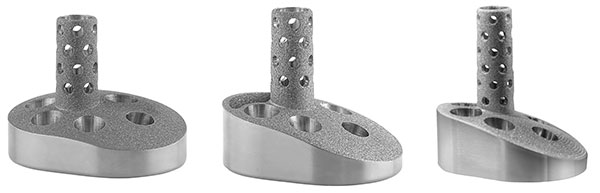
Traditional techniques to address glenoid bone loss required extensive bone grafting to lateralize the joint line or required compromised/medialized implant positioning with eccentric glenoid bone reaming. Augmented baseplates provided surgeons with a simpler, more balanced solution to preserve bone while restoring the joint line, since eccentric glenoid bone reaming is not required.
When augments were first introduced in 2011, the idea of using metal to correct a glenoid bone defect was met with hesitation, due primarily to concerns about glenoid loosening.
“There was definitely a lot of skepticism in those early years,” said Chris Roche, Sr. Vice President of Extremities at Advita. “We were told by a lot of people that these were going to fail. However, we trusted our test results which utilized a novel in-house test method that simulated rTSA loading conditions for each of these different types of glenoid bone defects. A few years later, that test method was adopted by the ASTM as the standard method to evaluate rTSA glenoid loosening.”
Using this unique test method, three distinctive Equinoxe augmented baseplates were developed:
- 10° superior augments
- 8° posterior augments
- 10° superior/8°posterior combined augment
At the time, these defect-correcting augments represented a new approach, one that challenged traditional reconstruction techniques. Surgeons were cautious, weighing whether the technology could deliver consistent, long-term outcomes.
But over time, that skepticism began to shift.
“From the very beginning, we collected clinical outcomes data on these augmented implants, and we published the results for each augmented baseplate type,” said Thomas Wright, MD. “With positive clinical outcomes, confidence in augmented glenoid baseplates increased – not just within the Equinoxe system, but across the broader orthopedic community, ultimately resulting in augmented glenoid baseplates becoming the standard implant treatment solution for rTSA patients with glenoid bone loss.”
Surgeon Perspective
For surgeons, the significance of augments lies in the expanded treatment options they provide.
“Augmented baseplates give surgeons the ability to select an implant that fits a patient’s deformity,” added Ryan Simovitch, MD. “Prior to augments, we had to modify the anatomy to fit a standard implant, which requires the removal of a lot more glenoid bone. Augmented baseplates are a simpler, more efficient, and more personalized solution for patients.”
Over time, what was once considered a niche solution has become a standard treatment solution.
...Augmented baseplates have improved our ability to restore glenoid anatomy and preserve bone while addressing bone loss...
“The development of augmented baseplates for reverse shoulder arthroplasty was a true game-changer,” said Joseph Zuckerman, MD. “Augmented baseplates have improved our ability to restore glenoid anatomy and preserve bone while addressing bone loss. When combined with pre-operative planning and intraoperative navigation, augmented baseplates have definitely improved patient outcomes after shoulder arthroplasty. I cannot imagine performing this procedure without these implants since I now use an augmented glenoid baseplate in over 80% of my rTSA cases.”
In fact, adoption has grown to the point where augment usage now exceeds standard baseplates in many cases, reflecting both clinical confidence and the evolving complexity of cases being treated.
As rTSA continues to evolve, augments have become a key component in addressing complex reconstruction scenarios.
A Milestone Measured in Patients
The 15-year anniversary of the first augmented rTSA baseplate procedure is more than just a clinical milestone, it represents an outstanding medical technological achievement and the development of a new standard of care for reverse shoulder arthroplasty. More than that, it reflects the trust that surgeons worldwide have in this technology to help treat their patients.
For Roche, the milestone is best understood through that impact.
“What started as a simple idea to replace lost bone with metal has expanded beyond a niche and has been embraced by surgeons all over the world as the simplest and most effective technique to treat glenoid bone loss,” he said.
As reverse shoulder arthroplasty evolves in the years to come, augmented baseplates will remain a critical tool to help surgeons treat their most challenging patients.