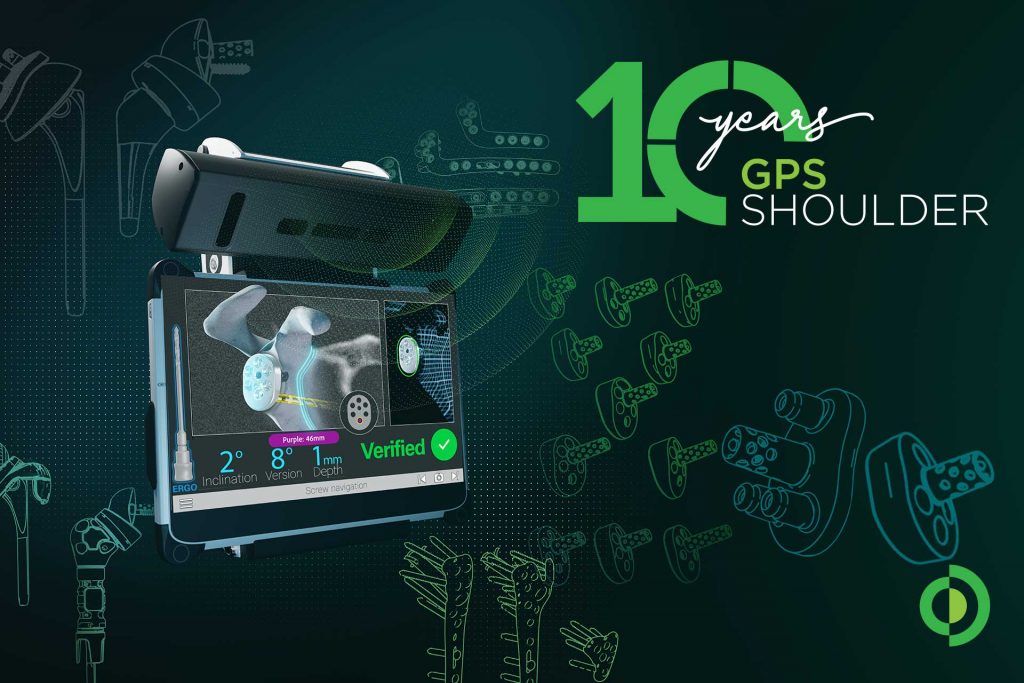
A Decade of Clinical Experience
Ten years and more than 80,000 cases have created a depth of clinical experience around GPS Shoulder that continues to inform its use and evolution.
Clinical evidence has demonstrated the value of intraoperative navigation, including a shorter learning curve for surgeons, improved precision in implant placement,3-4 improved outcomes,5 and lower rates of postoperative complications and revisions.5
It gives me information I can use in real time, while still allowing me to rely on my experience and judgment.
Michael O’Brien, MDOrthopedic Shoulder and Elbow Specialist
For Michael O’Brien, MD, orthopedic shoulder and elbow specialist with a background in sports medicine, incorporating GPS into his practice felt like a natural evolution.
“Technology has always been part of how I practice, so incorporating GPS felt very intuitive,” he said. “It gives me information I can use in real time, while still allowing me to rely on my experience and judgment. GPS makes me a better surgeon.”
Navigation is not intended to replace surgical judgment or expertise. At its best, it can become an extension of both, connecting what the surgeon sees and plans preoperatively with information available during execution.
And as surgeons gain experience with navigation, its role can evolve as well. What may begin as a tool used selectively for challenging cases can become part of a routine workflow, providing continuous data and feedback.
A founding member of the shoulder system and longtime advocate for GPS Shoulder, Joseph Zuckerman, MD, has been part of the journey since its early development. His involvement spans a period in which shoulder navigation progressed from an emerging concept to a technology used routinely across a significant portion of Advita’s shoulder procedures.
...Ten years and more than 100,000 cases later, what excites me most is how much opportunity remains to continue advancing what navigation can do for surgeons and their patients...
Joseph Zuckerman, MDFounding Member of the Shoulder System
“When we first began working with navigation in shoulder arthroplasty, we saw an opportunity to better connect preoperative planning with execution in the operating room,” he said. “Ten years and more than 100,000 cases later, what excites me most is how much opportunity remains to continue advancing what navigation can do for surgeons and their patients.”
A decade of progress has been made possible by surgeons around the world who have used GPS, challenged it and helped refine it, case after case.