August is National ASC Month, a time to recognize the growing role ambulatory surgery centers play in delivering high quality, efficient care. As ASCs take on increasingly complex procedures, they are also evolving to meet the demands of a changing surgical environment.
From O.R. space and capital investment to instrumentation and technology, the ASC business model demands a fundamentally different approach to delivering care. Surgeons and ASC leaders are seeing that evolution firsthand, and increasingly, it’s the details that make the difference.
A Strategic View from the C-Suite
Tammy Smittle, RN, BSN, MHA, Group COO/CNO of Northwest Hills Surgical Hospital, sees the growth of outpatient surgery as both an opportunity and a strategic challenge.
...Ambulatory surgery isn’t just an efficiency play; it’s an economic engine...
“Ambulatory surgery isn’t just an efficiency play; it’s an economic engine,” Smittle explains. “As more complex procedures move outpatient, ASCs that invest early in infrastructure and partnerships will be positioned to lead.”
Her perspective reflects a broader shift: success in the ASC isn’t simply about moving cases out of the hospital. It requires thoughtful decisions around staffing, infrastructure, technology and long-term strategy.


Designing Technologies for the ASC
For shoulder surgeon Rick Papandrea, MD, those decisions start with the realities of the operating room.
...Space is limited, so we need portable technology...
“Space is limited, so we need portable technology that can move with us as we switch rooms,” Dr. Papandrea said. “If we can bring something in without a capital investment, that’s ideal.”
That same emphasis on simplicity extends to instrumentation. Chris Christensen, MD, points to Advita Ortho’s hip instrumentation as one example.
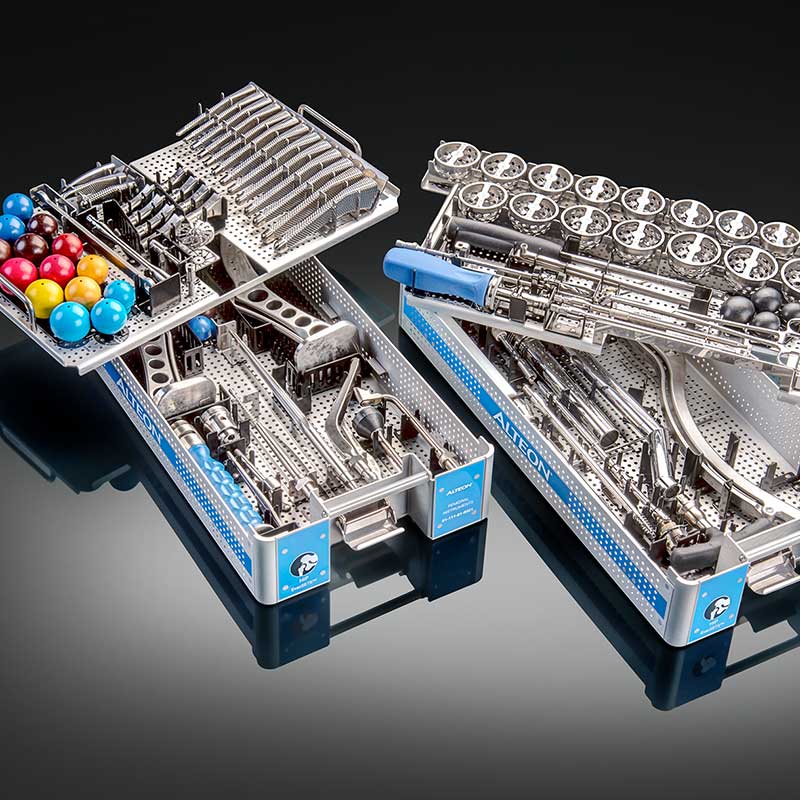
“I love the two-tray system [for the Advita Hip Instrumentation], because the room can be prepared more quickly,” Dr. Christensen said. “I don’t hear the technicians complaining about how many pans are having to be opened up to do a case. I also love the efficiency and simplicity of the neck and offset options.”
For ASCs, seemingly small improvements in setup and workflow can have a meaningful impact across a busy surgical schedule.
Efficiency Starts with the Patient
Knee surgeon Earl Kilbride, MD, MHA, has spent years refining outpatient approaches for joint reconstruction and sports medicine.
“The outpatient environment allows us to focus on what really matters: patients and their outcomes,” Dr. Kilbride said. “When you can streamline care, reduce hospital stays, and give people confidence that they’ll be back on their feet faster, it changes the whole equation.”
...Outpatient surgery allows us to deliver strong outcomes in a more efficient setting...
Dustin Sepich, MD, an orthopedic surgeon specializing in adult hip and knee reconstruction, sees the same potential.
“Outpatient surgery allows us to deliver strong outcomes in a more efficient setting, which streamlines care and focuses on what matters most,” Dr. Sepich said.


Advancing Life in the ASC
This National ASC Month, the evolution of outpatient surgery is worth recognizing, and advancing. As more complex procedures move into the ASC, the question is no longer simply where surgery happens, but how we can make that environment work better for surgeons, hospitals and, ultimately, patients.